
Cookie preferences
This website uses cookies, which are necessary for the technical operation of the website and are always set. Other cookies, which increase the comfort when using this website, are used for direct advertising or to facilitate interaction with other websites and social networks, are only set with your consent.
Configuration
Technically required
These cookies are necessary for the basic functions of the shop.
"Allow all cookies" cookie
"Decline all cookies" cookie
CSRF token
Cookie preferences
Currency change
Customer recognition
Customer-specific caching
Individual prices
PayPal payments
Selected shop
Session
Comfort functions
These cookies are used to make the shopping experience even more appealing, for example for the recognition of the visitor.
Note
Statistics & Tracking
Affiliate program
Track device being used
Composer: Heinrich Scheidemann
12 Organ Intabulations | Volumes III
Organ
- Order No. 2196
- ISMN: 979-0-2044-2196-1
- Number of pages 40 Seiten
- Kind of publication Score
- Instrumentation Organ
- Editor Johnson, Cleveland
- Level of difficulty medium
Among the organ tablatures of the early 17th century, the intabulations of motet-like figural... more
"12 Organ Intabulations | Volumes III"
Among the organ tablatures of the early 17th century, the intabulations of motet-like figural music by the Hamburg organist Heinrich Scheidemann are particularly noteworthy.
In church services, it was expected that a motet, a type of figural music normally sung by the choir, would be performed at a certain point. The only choir in the city of Hamburg could usually only manage to perform at one of the four main churches. In all other church services, the organist had to take on the duty of playing the appropriate motet on the organ. The ability to transcribe vocal music for the organ was therefore essential for organists in Hamburg and was highly valued. In many cases, the transcriptions were taken over note for note. Occasionally, the organist would “compose” complex, ornate arrangements based on the vocal models. Heinrich Scheidemann is considered one of the most important organists of this genre.
This edition was created with the aim of adapting the unique intabulation structure to a modern keyboard range, thus
transposing the artistic arrangements into modern notation.
In church services, it was expected that a motet, a type of figural music normally sung by the choir, would be performed at a certain point. The only choir in the city of Hamburg could usually only manage to perform at one of the four main churches. In all other church services, the organist had to take on the duty of playing the appropriate motet on the organ. The ability to transcribe vocal music for the organ was therefore essential for organists in Hamburg and was highly valued. In many cases, the transcriptions were taken over note for note. Occasionally, the organist would “compose” complex, ornate arrangements based on the vocal models. Heinrich Scheidemann is considered one of the most important organists of this genre.
This edition was created with the aim of adapting the unique intabulation structure to a modern keyboard range, thus
transposing the artistic arrangements into modern notation.
Content:
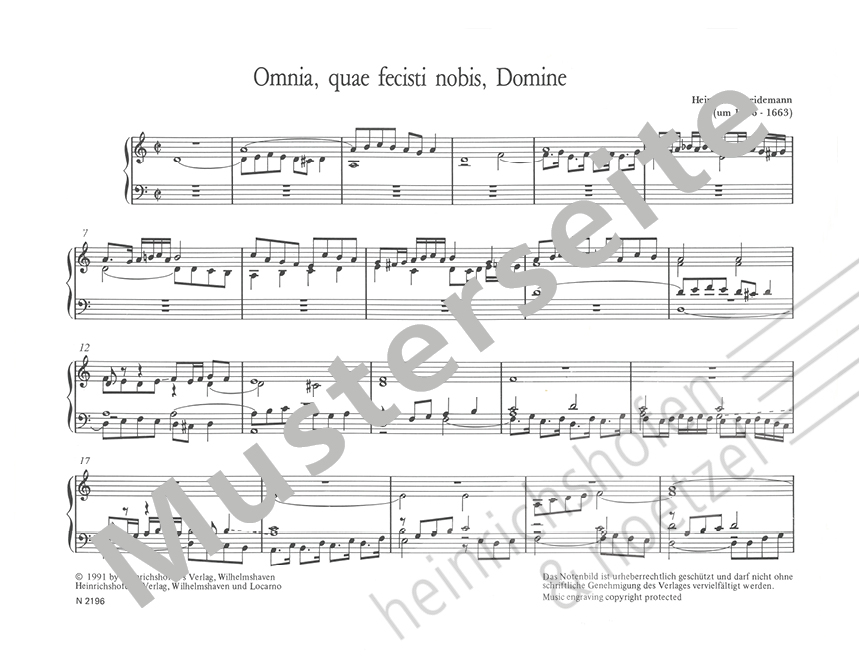
10. Omnia, quae fecisti nobis, Domine
11. Surrexit pastor bonus
12. Verbum caro factum est
Critical Commentary (Volume I - III)
Read, write and discuss reviews... more
Customer evaluation for "12 Organ Intabulations | Volumes III"
Write an evaluation
Evaluations will be activated after verification.
Heinrichshofen Verlag GmbH & Co.KG more
Manufacturer (GPSR)
Viewed


